If you've ever left a regular table tennis table outside for even a single monsoon season in Delhi, you probably already know the answer to why this topic matters. The surface warps, the laminate starts peeling at the edges, moisture creeps into the core, and within a few months what used to be a smooth playing surface turns into something closer to a wavy skating rink. It's a heartbreaking thing to watch, especially if you spent good money on it hoping it would last years. So when people start asking about an outdoor TT table, the very first question that should come up isn't about colour or brand logos. It's simply this: what actually makes a table weatherproof, and how do you tell a genuinely outdoor-ready table from one that's just an indoor table with a fresh coat of paint?
We work with these tables often enough to have strong opinions on this, so let's break it down properly.
It Starts With the Core Material, Not the Paint Job
A lot of people assume weatherproofing is mostly about the paint or coating on top, and that's honestly one of the biggest misconceptions in this space. Paint can protect a surface for a while, sure, but if the material underneath isn't built to handle moisture and temperature swings, the paint is just delaying the inevitable. Genuine outdoor tables use a core material that resists water absorption at a structural level, not just a surface level.
This is where something like Fabrinox comes into the conversation. It's a specially engineered material used specifically for outdoor sports furniture because it's built to resist rust, corrosion, and moisture penetration far better than standard laminated wood or basic metal sheeting. Unlike a table where moisture eventually seeps through microscopic gaps and starts breaking down the internal structure from the inside out, a table built with this kind of material stays dimensionally stable even after repeated exposure to rain, humidity, and sun. That stability is the entire foundation of weatherproofing. Everything else, the coatings, the frame treatment, the edge sealing, is secondary to getting this part right.
The Frame and Legs Matter More Than People Realise
Everyone focuses on the tabletop because that's what you see and play on, but the frame and legs take an enormous beating outdoors too. Rainwater pools at the base, humidity sits around the joints, and if the frame isn't properly galvanized or treated against rust, you'll start seeing corrosion at the legs and support beams long before the tabletop itself shows any wear.
A properly weatherproofed outdoor table uses galvanized steel or a similarly treated metal frame that's designed to shrug off rust for years, not months. The welding points and joints also need to be sealed properly, because those tiny gaps are exactly where water finds its way in and starts causing damage from the inside. If you're evaluating a table and the seller can't clearly explain what the frame is made of and how it's treated against rust, that's usually a sign the table wasn't built with genuine outdoor use in mind.
UV Resistance Is the Silent Factor Most People Forget
Everyone thinks about rain when they think "weatherproof," but in a city like Delhi, the sun does just as much damage over time, if not more. Constant UV exposure breaks down cheaper coatings, causes fading, and makes surfaces brittle over months of direct sunlight. A table sitting on a terrace or in a garden through Delhi's harsh summers needs UV-stabilised coatings that resist fading and surface degradation, not just water-resistant ones.
This is actually a good practical test when you're checking out a table in person or reading its specifications. Ask specifically about UV resistance, not just waterproofing. A lot of tables marketed as "outdoor" only really account for rain protection and completely ignore sun damage, which means the surface colour fades and the playing surface gets rougher within a year or two, even if water was never really an issue.
Drainage Design, the Detail Nobody Thinks to Ask About
Here's a small but genuinely important detail. A flat, perfectly smooth outdoor surface sounds ideal, but it can actually be a problem because rainwater has nowhere to go and just pools on top. Good outdoor TT tables are engineered with a very slight surface gradient or drainage channels built in, so water naturally runs off instead of sitting there for hours after a downpour. Standing water, even in small amounts, is one of the fastest ways to degrade a tabletop surface over time, so this detail matters a lot more than it sounds like it should.
Why This Matters Even More If You're Considering a Dining Table Tennis Table
A growing number of people, especially those setting up a luxury game room at home, are now going for a dining table tennis table, which is essentially a table that functions as a regular dining table and converts into a table tennis table when needed. It's a brilliant, space-saving idea, especially for homes where a dedicated games room isn't realistic.
But if you're placing this kind of table in a semi-outdoor space like a covered terrace, balcony, or an open-sided pergola area, the weatherproofing question becomes even more important, not less. These tables often get used more frequently as furniture, meaning they're exposed to daily wear on top of weather exposure. The material and build quality need to hold up not just against occasional rain but against regular use as a dining surface too, with plates, cups, condensation rings, and general household activity added into the mix. A table that's only lightly weather-resistant will show wear far faster under this kind of dual use.
Building a Genuine Luxury Game Room Outdoors
If you're setting up a proper luxury game room that spills into an outdoor or semi-outdoor space, the table you choose is essentially a long-term investment, not a seasonal purchase. It's worth spending the extra time asking the right questions before buying, rather than discovering the hard way after one monsoon that the table wasn't actually built for outdoor conditions.
Ask about the core material and whether it's something purpose-built for outdoor use, like Fabrinox, rather than a standard laminate with a waterproof label slapped on. Ask about the frame treatment and rust resistance. Ask specifically about UV stability, not just water resistance. And if possible, ask for a table that's already been tested through at least one full outdoor season, because real-world performance tells you far more than a specification sheet ever will.
A genuinely weatherproof outdoor TT table isn't about one single feature doing all the work. It's the combination of the right core material, a properly treated frame, UV-resistant coatings, and thoughtful design details like drainage that together let a table survive years of sun, rain, and daily use without falling apart. Get these fundamentals right, and what you're left with isn't just a table that survives outdoors, it's one that genuinely becomes a permanent, reliable part of your outdoor living space.
FAQs
1. What makes an outdoor TT table weatherproof?
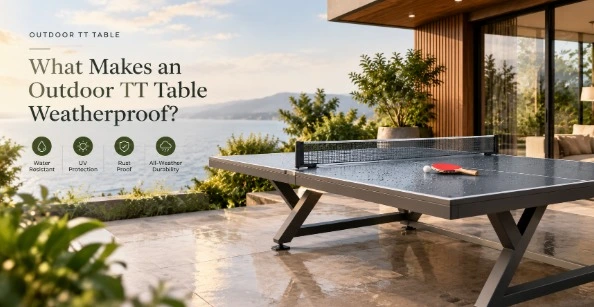
A weatherproof TT table uses moisture-resistant materials, a rust-resistant frame, UV-protected surfaces, and effective water drainage.
2. Can a regular TT table be used outdoors?
Regular indoor tables are not designed for prolonged exposure to rain, humidity, and sunlight. An outdoor-specific table is a better choice.
3. Why is UV resistance important for outdoor TT tables?
UV resistance helps prevent fading, surface damage, and deterioration caused by prolonged exposure to direct sunlight.
4. What material is best for an outdoor TT table?
Purpose-built outdoor materials such as Fabrinox can provide better resistance to moisture, corrosion, and changing weather conditions.
5. Can a dining table tennis table be used outdoors?
Yes, but for semi-outdoor spaces, choose a model specifically designed to withstand moisture, sunlight, and regular everyday use.
Latest Blogs